If you're developing with the new Windows.Web.UI.Interop.WebViewControl you may have noticed you cannot navigate to localhost HTTP servers. This is because the WebViewControl's WebView process is a UWP process. All UWP processes by default cannot use the loopback adapter as a security precaution. For development purposes you can allow localhost access using the checknetisolation command line tool on the WebViewControl's package just as you can for any other UWP app. The command should be the following:
checknetisolation loopbackexempt -a -n=Microsoft.Win32WebViewHost_cw5n1h2txyewyAs a warning checknetisolation is not good on errors. If you attempt to add a package but get its package family name wrong, checknetisolation just says OK:
C:\Users\davris>checknetisolation LoopbackExempt -a -n=Microsoft.BingWeather_4.21.2492.0_x86__8wekyb3d8bbwe
OK.[1] -----------------------------------------------------------------
Name: AppContainer NOT FOUND
SID: S-1-15-...There's also a UI tool for modifying loopback exemption for packages available on GitHub and also one available with Fiddler.
As an additional note, I mentioned above you can try this for development. Do not do this in shipping products as this turns off the security protection for any consumer of the WebViewControl.


 Amazon doesn't say how it determines friendship because that exposes work around
or because we would be creeped out? https://twitter.com/niftyc/status/618275252049608704 …
Or from GitHub's POV, how else can you use this XSS? Example: Open a new window
with info on howto subvert particular censorship. What else?
Amazon doesn't say how it determines friendship because that exposes work around
or because we would be creeped out? https://twitter.com/niftyc/status/618275252049608704 …
Or from GitHub's POV, how else can you use this XSS? Example: Open a new window
with info on howto subvert particular censorship. What else?
 Jacob Rossi
@jacobrossi :
Jacob Rossi
@jacobrossi :URI Design & Ownership - On the issues with and alternatives to requiring well known filenames and extensions in URIs. You must love the draft’s URI.

When they went to the Moon, they received the same per diem compensation as they would have for being away from base in Bakersfield: eight dollars a day, before various deductions (like for accommodation, because the government was providing the bed in the spaceship).
Apollo 11’s Astronauts Received an $8 Per Diem for the Mission to the Moon
The astronauts of Apollo 11: Intrepid explorers. Inspirational heroes. Government employees.
Read more. [Image: Reuters]
451 Unavailable for Legal Reasons: The 451 status code is optional; clients cannot rely upon its use. It is imaginable that certain legal authorities may wish to avoid transparency, and not only forbid access to certain resources, but also disclosure that the restriction exists.
That was fast.
A House subcommittee has passed the Global Online Freedom Act (GOFA), which would require disclosure from companies about their human rights practices and limit the export of technologies that “serve the primary purpose of” facilitating government surveillance or censorship to countries designated as “Internet-restricting.”
Fictional plot summaries of TNG S8 episodes. Like:
As a professional URI aficionado I deal with various levels of ignorance on URI percent-encoding (aka URI encoding, or URL escaping).
Worse than the lame blog comments hating on percent-encoding is the shipping code which can do actual damage. In one very large project I won't name, I've fixed code that decodes all percent-encoded octets in a URI in order to get rid of pesky percents before calling ShellExecute. An unnamed developer with similar intent but clearly much craftier did the same thing in a loop until the string's length stopped changing. As it turns out percent-encoding serves a purpose and can't just be removed arbitrarily.
Percent-encoding exists so that one can represent data in a URI that would otherwise not be allowed or would be interpretted as a delimiter instead of data. For example, the space character (U+0020) is not allowed in a URI and so must be percent-encoded in order to appear in a URI:
http://example.com/the%20path/
http://example.com/the path/
For an additional example, the question mark delimits the path from the query. If one wanted the question mark to appear as part of the path rather than delimit the path from the query, it must be percent-encoded:
http://example.com/foo%3Fbar
http://example.com/foo?bar
/foo" from the query "bar". And in the first, the querstion mark is percent-encoded and so
the path is "/foo%3Fbar".

FTA:
The MPAA is getting pretty desperate, it seems. MPAA boss Chris Dodd was out trying to defend censoring the internet this week by using China as an example of why censorship isn’t a problem. It’s kind of shocking, really.
“When the Chinese told Google that they had to block sites or they couldn’t do [business] in their country, they managed to figure out how to block sites.”



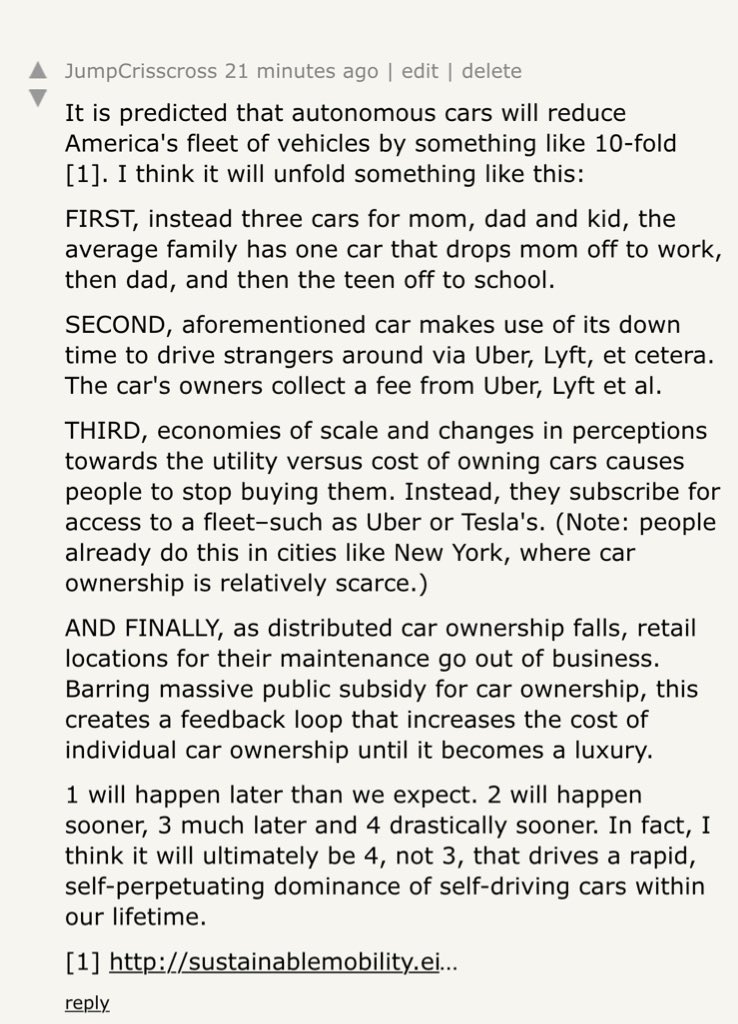
 This seems like the way car ownership declines
  Oh god,
 Summary of Scalia’s dissent.
 Some rights reserved